

Business rules
This page describes the rules that govern how payment defaults are created, published, managed, and deleted through the API.
Publication Requirements
All Payment Default Register requirements must be fulfilled before a payment default can be published.
The primary publication requirements are:
- The debt has existed for at least 45 days
- The outstanding debt amount is at least EUR 30
- All mandatory data has been provided correctly
- Debtor notification requirements have been fulfilled
Debt Age
The creditor must provide the debt start date when creating a payment default.
The debt start date is used to determine whether publication requirements have been met.
To initiate the debtor notification process, the debt must have existed for at least 38 days.
To publish a payment default, the debt must have existed for at least 45 days.
Mandatory Data
When creating a new payment default, the following information must be provided:
- Debtor personal identification code or registration code
- Contract or invoice number
- Debt start date
- Outstanding debt amount
At least one primary notification channel must also be provided:
- Email address; or
- Postal address
Additionally, the following information may be provided:
- Phone number for SMS notifications
- Bank account number
- Reference number
The debtor's name is not submitted through the API.
All monetary amounts must be submitted in EUR.
Payment Default Lifecycle
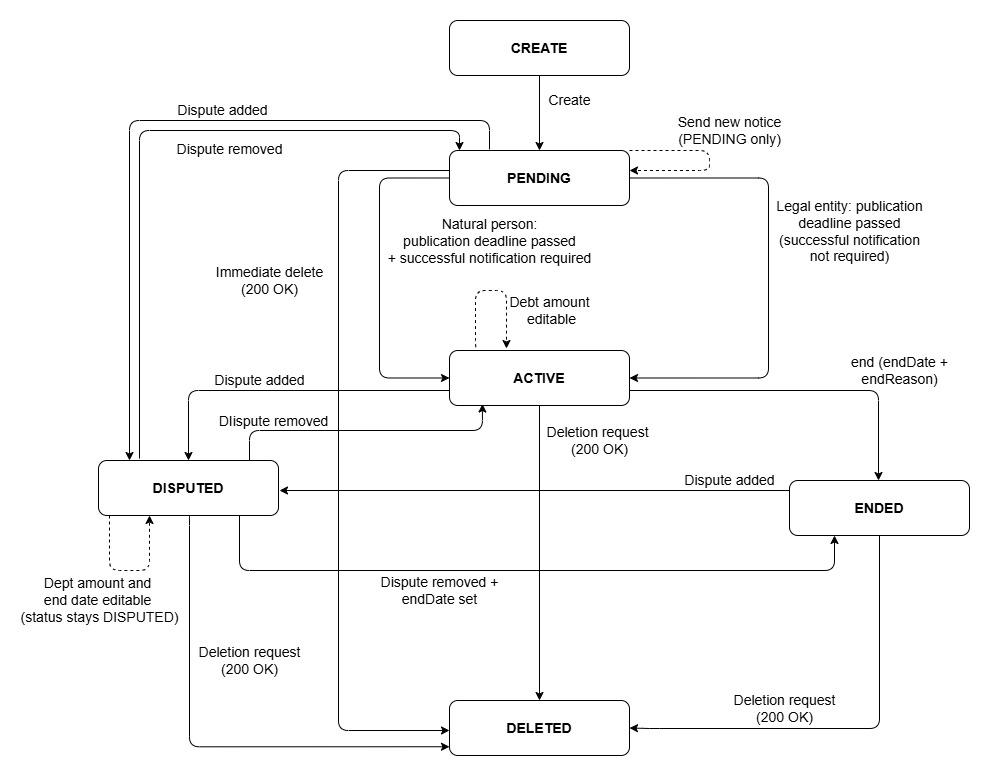
Payment Default Lifecycle
PENDING
The payment default is awaiting publication.
In PENDING status:
- The payment default is not publicly visible
- Additional notifications can be sent to the debtor
- The payment default can be deleted
- The debt amount cannot be changed
ACTIVE
The payment default has been published.
In ACTIVE status:
- The debt amount can be updated
- The payment default can be ended
- A deletion request can be submitted
DISPUTED
The payment default is under dispute.
In DISPUTED status:
- The debt amount can be updated*
- An end date and end reason can be added*
- A deletion request can be submitted*
Adding end information does not automatically change a previously active and currently disputed payment default to ENDED status.
If the dispute is removed and an end date has previously been added, the payment default moves to ENDED status and does not become ACTIVE again.
*The modifications allowed on a disputed payment default depend on the status that preceded the dispute. If the payment default was in PENDING status before being disputed, the amount cannot be changed and an end date cannot be added. If the payment default was in ENDED status before being disputed, the amount cannot be changed.
ENDED
The payment default has been ended.
In ENDED status:
- The debt amount can no longer be modified
- A deletion request can be submitted
DELETED
The payment default has been deleted.
Deleted payment defaults are returned with limited information.
For a payment default with DELETED status, only the following information can be queried:
- Payment default identifier
- Status
- Deletion date
Debtor Notification
Before publication, the debtor is notified using the contact details provided by the creditor.
The creditor may provide:
- One or more email addresses
- One or more postal addresses
- One or more phone numbers for SMS notifications
Notifications are sent to all contact details provided by the creditor.
SMS is an additional notification channel and does not replace email or postal notifications.
The creditor may specify the notification language separately for each notification channel.
Supported languages are:
- Estonian (
et) - English (
en) - Russian (
ru)
Notification Success Requirements
For natural persons, at least one primary notification channel must be successful:
- Email; or
- Post
If none of the primary channels are successful, the payment default will not be published.
For legal entities, successful notification is not a prerequisite for publication.
Notification Deadline
The minimum notification period is 7 days.
Notification deadlines are calculated using business days - if a deadline falls on a weekend or public holiday, it is moved to the next business day.
A payment default is published only after the notification deadline has passed.
Sending a New Notification
A new notification may be sent only for a payment default in PENDING status.
When sending a new notification, the creditor may provide updated contact details.
A new notification is sent to all contacts included in the request.
If a new email address or postal address is added, the publication date is recalculated and publication is postponed according to the applicable notification rules.
Adding only SMS contact details does not affect the publication date.
The system does not check whether a notification has previously been sent to the same contact.
Duplicate Detection
A payment default is considered a duplicate when all of the following match within the same creditor account:
- Debtor
- Contract or invoice number
- Debt start date
A validation error is returned when attempting to create a duplicate payment default.
If the previous payment default has been ended and the new payment default relates to a new debt (with a different debt start date), a new payment default may be created.
Updating the Debt Amount
The debt amount may be updated for ACTIVE and DISPUTED payment defaults.
The debt amount cannot be updated while the payment default is in PENDING, ENDED or DELETED status.
If the payment default status is PENDING and the amount needs to be changed, the creditor must:
- Delete the existing PENDING payment default
- Create a new payment default
- Complete a new notification process
Modifiable Data
The following fields cannot be modified after a payment default has been created:
- Debtor identifier
- Contract or invoice number
- Debt start date
The ability to modify data depends on the payment default status.
| Field | PENDING | ACTIVE | DISPUTED | ENDED |
|---|---|---|---|---|
| Debt Amount | No | Yes | Yes | No |
| Contact Details / New Notification | Yes | No | No | No |
| End Date | No | Yes | Yes | No |
| End Reason | No | Yes | Yes | No |
| Publication End Date | No | Yes | Yes | Yes |
Publication End Date
The publication end date defines the date until which a payment default may remain publicly visible.
The field is optional and its availability depends on the permissions assigned to the creditor.
The publication end date may be:
- Specified during creation
- Added later
- Modified
- Removed
The publication end date can be managed for payment defaults with the following statuses:
- ACTIVE
- DISPUTED
- ENDED
The publication end date cannot be modified for DELETED payment defaults.
When the publication end date is reached, publication is automatically ended.
Adding, modifying, or removing the publication end date does not change the payment default status.
A payment default does not need to be ended before a publication end date can be assigned.
Deletion
A creditor may directly delete a payment default that is in PENDING status.
For ACTIVE, DISPUTED, and ENDED payment defaults, a deletion request is created.
When a deletion request is submitted:
- The payment default status remains unchanged
- A response is returned indicating that the deletion request is under review
- The request is forwarded to Creditinfo's internal review process
The creditor is notified of the final decision by email.
Queries and Visibility
A creditor may only query payment defaults associated with their own account.
Payment default list queries return:
- Payment default identifier
- Status
- Amount
For payment defaults with DELETED status, only the following information is returned:
- Payment default identifier
- Status
- Deletion date
Payment default detail queries return complete information.
For payment defaults with DELETED status, only the following information is returned:
- Status
- Deletion date
Notification queries provide information about:
- Notification channel
- Recipient
- Sending time
- Delivery result
- Possible error messages
Notification information is not returned for payment defaults with DELETED status.
For payment defaults in PENDING status, the API also returns the estimated publication date, which is calculated dynamically based on notification deadlines, business-day rules, and additional notifications.
Updated about 2 months ago